Want to increase your sign ups and commissions?


In the highly competitive world of travel SEO, catching the eye of adventurers and holidaymakers can be challenging. To make your mark, you need a successful SEO strategy highlighting your unique experiences.
Our SEO agency is aware of how tricky it can be to do SEO for travel websites. So we’re going to bring you everything our professional team would do for a travel company to help your website climb search engines.
Want to increase your sign ups and commissions?
Understanding SEO is key for making your travel website pop up where travellers are looking. Getting your travel site to show up first in search results means more eyes on your travel packages or blog. It’s all about making sure your site is the first stop for anyone planning their next adventure.
As a travel website, search engine optimisation helps you establish credibility and trustworthiness in a busy market. By creating well-optimised content that shares breathtaking destinations, travel tips and the latest in travel trends, you become the go-to guide for travel information. This not only increases engagement but opens the door to more booking opportunities and partnerships for you.
Researching the search phrases travellers use when looking for their next adventure is what you’re after in keyword research. Aim to make your site the ultimate guide for travel and destinations. This earns you points with Google, ranking your articles and guides higher in search results.
Consider the unique experiences your travel service offers. Highlight these as your main attractions. These services become your pillar pages for which you can create a topic cluster. To create a cluster you need a keyword strategy that includes every keyword that relates to the main pillar page.
Tools like Ahrefs or Answer the Public are great for sparking ideas for content that explores every aspect of what you offer. For example, if you’re known for “Eco-Friendly Tours,” you might write about:
When you have every topic covered for your pillar pages, it’s time to create engaging content and build a network of links between your articles.
Top Eco-Friendly Destinations in [Area], How to Travel Sustainably with [Your Company], Tips for Eco-Conscious Travel.
When you properly connect pages on your travel website, you make it easy for visitors to navigate your travel website. This setup also lets search engines grasp the structure of your site and rank it more effectively.
Consider this structure as a starting point:
Homepage > Pillar Page > Articles
Homepage > Adventure Tours > Guide to Epic Adventures
This structure serves as the foundation for developing a collection of topic clusters and relevant supporting articles. Begin by linking articles to each pillar page, ensuring your links create a network like so:
Vary your internal links anchor text instead of sticking to exact matches; if an article is about “Adventure Tour Packing List,” change up your linking phrases so you don’t over-optimise. Effective internal linking leverages the power of your top pages to improve rankings across your site, not just the front page.
Each article links back to its pillar page, Each article is linked from another within the same topic cluster, Each pillar page connects to the homepage.
Every SEO plan needs a strategy and SEO for travel is no different. You’ll have to consider the type of travel stories, guides, and insights you’ll share. And on top of that how regularly you can publish articles and where to start first.
Your strategy should pinpoint what will make your travel site a go-to spot for travellers. Identify which topics are going to move the needle most for your travel company. When you have this knowledge it will provide you with your first steps.
Craft your content to highlight the adventures and experiences you offer, making your site irresistible to travellers. Keep your blog updated with posts on travel hacks, hidden gems, and updates from the travel world. This capitalises on trending and topical searches that can be easier to rank for.
Don’t forget to make these part of your travel content plan:
Solid SEO is more than just keywords. It’s about delivering content that captivates, educates, and inspires readers to pack their bags with your guidance.
Structured data, Keyword rich headings, Meta descriptions, FAQs.
Getting your travel website noticed in local searches can really set you apart. If you have physical locations, make sure your Google Business Profile is updated and filled with relevant keywords that describe your services.
This not only ranks your travel business in Google search results and Google Maps but also opens the door for travellers to drop reviews. Having people talk about their amazing travel experiences with your service online is worth its weight in gold. So encourage happy travellers to share their stories. Positive feedback can really sway potential customers and lift your ranking in search results.
For your site, create pages aimed at local searches like “Adventure Tours in Perth.” Create unique content for each location you cover to keep things fresh and avoid duplicate content issues.
Securing links from respected and relevant sites signals to search engines that your travel content is reliable and deserves a higher ranking.
The ways we get valuable links include:
Aim for a mix of backlinks, particularly from travel-centric sites, to boost your site’s trust and authority. Smart link building does more than improve SEO, it can raise your site’s profile by putting you in front of a new audience.
Digital PR, Writing guest posts, Creating shareable infographics, Partnering up for collaborations.
Travel websites tend to have a lot of pages to target keywords across multiple locations and services. This makes it important to health check your site with a technical SEO audit. Give your site a health check at least once a year with tools like Screaming Frog and Google’s Page Insights.
Here are a few important things you should focus on:
Speeding up your site’s load time., Ensuring it’s mobile-friendly., Securing your site with HTTPS., Crafting short, descriptive, and keyword-focused URLs., Making your site easy for search engines to crawl., Using structured data to make your content clear., Tackling duplicate content issues with canonical tags or redirects., Keeping your site secure against threats., Implementing hreflang tags for multiple languages.
It’s important to consider how external influences such as changes in the economy or trending locations can impact the travel market. These factors can change traveller preferences so you want to be on top of them. Being flexible and well-informed keeps your travel company relevant and ahead of the curve.
Search engine optimisation isn’t about blindly following the system, it’s also about pairing it with an overall marketing strategy. By engaging in comprehensive market research and keeping an eye on what your competition is doing, you’ll be able to keep track of everything.
Companies are vying for visibility with keywords that have a high level of competition. The battle isn’t just about reaching the top of search engine results. It’s also about adapting to the ever-changing preferences and desires of travellers.
Implementing structured data and schema markup can improve the results of travel-related content. This can seem complex if you’ve not done it before, but it means you can get rich results in the search engine results pages. This helps to make your website stand out from those who don’t have it.
Matthew Barby
Senior Director of Acquisition at Hubspot

Whenever I have companies ask me if there are any great agencies in Australia, I always point them to Prosperity Media. James and team are always pushing out incredibly impactful work, and their depth of knowledge around SEO and content marketing is up there with the best in the world.
Marcus Lim
Co-Founder & CEO at Oneflare

We have experienced significant uplift and continued growth in organic traffic and have helped us to rank above all our competitors for key search terms.
Travel
FAQs
SEO in tourism is about improving your online presence to ensure it’s easily found for those organising vacations. It involves optimising your website with keywords, backlinks and high-quality content.
To start SEO for your company, begin by using keyword research tools identifying keywords that are pertinent to your business, optimising your web pages, and producing high-quality content. Concentrate on acquiring quality backlinks and regularly evaluate your website’s analytics.
To effectively promote your travel business, actively participate on social media platforms, make connections at travel industry events, partner with well-known personalities, provide distinctive travel experiences, and utilise email marketing strategies to maintain awareness of your brand among prospective customers.
Establish your presence on Google My Business and motivate your customers to leave positive feedback to improve your local SEO strategies. Also, try to rank for location-based keywords. This will help your search engine rankings draw customers in your area to your small enterprise.



With millions of busy Australians swapping shopping trollies for touchscreens, the battle for product visibility is no longer fought in the supermarket aisle. It’s fought in the search results of supermarket apps and websites. Digital shelf optimisation is the practice of strategically enhancing product listings on shopping platforms, so that when customers scroll through a […]
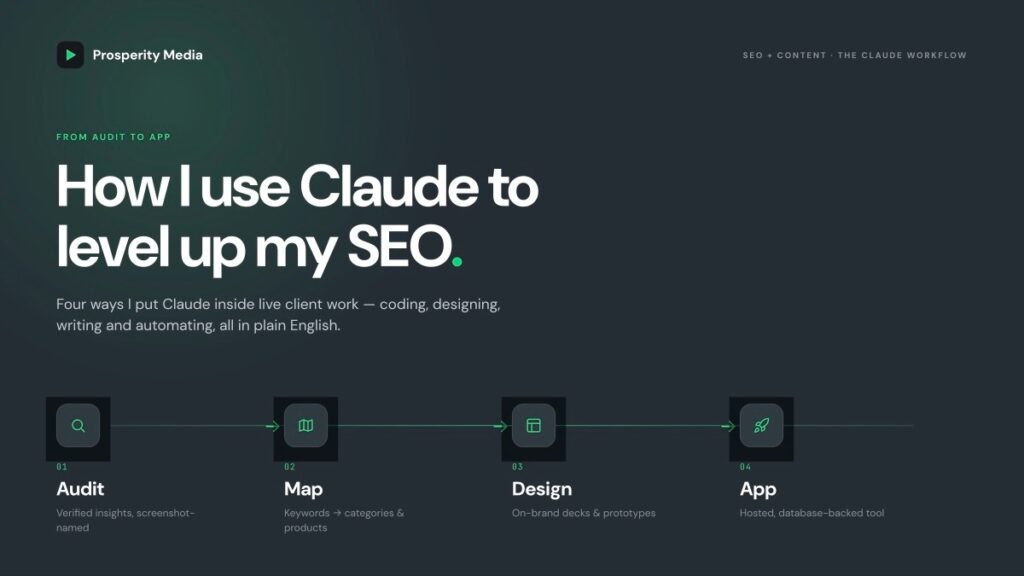
SEO has always been the discipline that borrows. We borrow developer time to ship a fix, designer time to make a deck land, a writer to turn a brief into a page, an analyst to make the numbers mean something. Most of us got passable at all of it, because the alternative was waiting in […]

When you’re trying to create optimised content, large language models like Google AI Mode and ChatGPT can feel like a black box. If content is your bread and butter, you’ll probably struggle to wrap your head around the deepest technical complexities of LLMs. Here’s the good news: You don’t need a computer science degree to […]
Key Takeaways Why Strategy Matters in Digital PR? In the world of digital PR, having a strategy isn’t a ‘nice to have’ – it’s the foundation of success. A strong strategy helps your client stand out against competitors rather than blending into the noise. Without clear direction, digital PR can quickly become a cycle of […]
We just published Prosperity Media’s State of AI Search White Paper and the data should make every brand marketer pay attention. Here are the findings that matter most: The shift is already happening 80% of consumers now rely on AI-generated results for at least 40% of their purchase searches and most of those searches end […]

If you are a marketer working across digital marketing strategy, inbound marketing, or content marketing, chances are you’ve stumbled across the term digital PR. But what does it actually mean, and what makes it different from traditional PR? For people outside of the Digital PR industry, the difference between Traditional and Digital Public Relations can […]
Search engine optimisation (SEO) is one of the most powerful tools in digital marketing, but only when it’s done well. With expert guidance, technical know-how, and custom strategies, a top SEO agency does far more than boost rankings and organic traffic. It can create new markets, stronger ROI, and long-term success in an online landscape […]

Electronic mail, or email (as it is now more commonly known), was invented in 1971 by Ray Tomlinson. Since then, it has slowly replaced snail mail due to its convenience and speed. While instant messaging has expanded quickly, email remains the backbone of professional communication. It is no longer just a means to message friends […]
Our Services
Let’s build something big together.
We’re not here for short-term wins. We’re here to scale what matters — traffic, trust, and growth. Let’s Grow Together
Work with us