Want to increase your sign ups and commissions?


Small businesses face a big challenge in getting noticed online against bigger competition. You need a small business SEO strategy that not only puts your business on the map but also showcases what makes it unique.
Our SEO agency has got results with small businesses in competitive industries. Here’s how we would get started doing SEO for small businesses.
An important note our small business SEO work starts at ,000 + GST per month, We do bespoke work based on your industry; we do not offer cookie-cutter packages, which are the same for all industries. Every industry is different and has different levels of competition. We work out a plan of action to drive revenue based on your industry.
Want to increase your sign ups and commissions?
SEO is key to getting your small business noticed on Google. When it’s done right, your business pops up first in search engines when potential customers are searching. A top spot in search results means more visits to your site, leading to more customers and growth.
If your local business doesn’t rank well, those potential customers might find their way to your competitors instead. For small businesses, being easy to find online can make all the difference in building a loyal customer base.
The first step is figuring out what potential customers might type into Google when looking for your products or services. Your aim is to become the go-to source for what you offer.
This can be done by becoming a topical authority in your niche. When you write about everything that is connected to your products or services it helps Google to understand what you’re about. This builds understanding which can be rewarded with a higher ranking.
Establish what your main service or products are. These will form the backbone of your pillar pages which are the pages that you want ranking the most. You then want to find every keyword related to that to build a topic cluster. Tools like Ahrefs or Answer the Public are great for keywords that relate to your offerings.
For example, if “Handmade Jewelry” is your speciality, you will need to create articles like so:
Now you have your target keywords,and topic cluster ready it’s time to build a network of internal links.
The Beauty of Handmade Jewelry, Choosing the Perfect Handmade Gift, The Craftsmanship Behind Handmade Jewelry.
Linking related pages within your small business website helps visitors navigate your site and search engines to crawl the structure of your site.
A simple structure might look like this:
Homepage > Pillar Page > Articles
Homepage > Handmade Jewelry > Discover the Art of Handmade Jewelry
This structure is ideal for developing an extensive collection of topic clusters. The articles exist to support your main pillar page content. The linking structure of this could look something like this:
Avoid using the same anchor text for every link. If you’re talking about “Unique Jewelry Designs,” mix up your anchor text to avoid over-optimising. Effective internal linking helps distribute your site’s SEO value across your whole site not just individual pages.
Each article links back to its pillar page, Articles within the same cluster link to at least one other article, Each pillar page connects back to the homepage.
You need to be defining your strategy for it to be the most effective. This should include the type of content you’ll create, how often you’ll post and where you’ll start.
Your strategy should focus on what will drive the most revenue for your business. Identify the pages that would benefit your small business the most if they were to rank high. This shows you where you should focus your efforts first so you can get the best return on your investment.
Design your content to highlight what makes your business special. Google is looking to reward unique and expert-created content. This is your chance to use that knowledge to give Google what it wants.
Keep your blog updated with insights into your products or services, tips and industry news. Using trending topics as part of your strategy can be an easier way to rank and build your brand image in the industry.
When planning your content, make sure to include:
Small business SEO isn’t just about keywords. It’s about creating content that informs, entertains and convinces the target audience that your small business is exactly what they’ve been looking for.
Structured data, Keyword-rich headings, Meta descriptions, FAQs.
Being visible in local searches is incredibly important for small businesses. If you have a physical location, your Google Business Profile will be a way for local people to find your business.
Keep your Google Business Profile up-to-date and include keywords that reflect your business’s services or products. This allows your business to rank in Google Maps which can show up on Google search results.
It also allows customers to leave reviews. Positive reviews from customers not only act as social proof which helps conversions but it can help your ranking.
To do local SEO for your website you’ll want to create pages on your website targeting local searches like “Handmade Jewelry in Melbourne,”. Make sure that each page has unique content to avoid duplication issues.
Securing quality backlinks from reputable sites within your industry signals to search engines that your small business’s content is credible. and deserves a higher ranking.
Strategies we use for building these links include:
You should go for a range of backlinks to strengthen your site’s authority. To get the best result you’ll want to ensure that most of the links are from websites relevant to yours. Link building is not only good for SEO but it allows you to put your brand in front of new audiences also.
Digital PR, Guest posts, Shareable infographics, Collaborations.
A technical SEO audit is like a check-up for your website. It makes sure that everything underneath the hood is running smoothly. For smaller websites, it’s not as necessary to run as there’s less that can go wrong but it’s still a good idea so you know what’s going on.
It’s best to run an annual check of your site using tools like Screaming Frog and Google’s Page Insights. A few things that every SEO audit should look for include:
Ensuring quick loading times, Optimising for mobile users, Using HTTPS for security, Keeping URLs short and keyword-rich, Making your site easy for search engines to crawl, Structured data, Addressing duplicate content properly, Maintaining website security, Setting up hreflang tags if necessary.
Spending time to analyse the market you’re in can help to stay ahead of the competition. It’s about knowing who your customers are, what they’re searching for online, and how they prefer to find information about your products or services.
This insight allows you to create content that speaks directly to their needs and interests, making your website more likely to show up in search results when potential customers are looking for what you offer.
As a small business, you have the advantage of being more nimble than big companies. It should be quicker to make decisions and react to market changes. This is why having your finger on the pulse of the market is important.
Small businesses often face unique SEO challenges. Limited budgets mean every dollar spent on SEO needs to work harder. You’re also up against bigger companies with more resources.
Understanding the technical aspects of SEO, like website speed and mobile optimisation, can be tricky. Plus, SEO best practices keep changing so staying informed and adaptable is a full-time job. This is why it can help to invest in a dedicated specialist or agency to get the best results.
With so many small businesses failing within the first few years, a strong organic ranking can be the difference. It levels the playing field against larger competitors by allowing you to appear alongside them in search results. This visibility leads to more organic traffic without the need for a big advertising budget.
Small business SEO also targets quality traffic; people finding your site through search engine results are often more interested in what you’re offering. Over time, effective small business SEO builds your brand’s credibility and trust with potential customers. And unlike paid ads, the benefits of SEO don’t stop the moment you stop paying for them.
Matthew Barby
Senior Director of Acquisition at Hubspot

Whenever I have companies ask me if there are any great agencies in Australia, I always point them to Prosperity Media. James and team are always pushing out incredibly impactful work, and their depth of knowledge around SEO and content marketing is up there with the best in the world.
Marcus Lim
Co-Founder & CEO at Oneflare

We have experienced significant uplift and continued growth in organic traffic and have helped us to rank above all our competitors for key search terms.
Small Businesses in competitive industries
FAQs
Our pricing starts at $3,500 + GST per month for small business SEO campaigns. We mainly work with small businesses in more competitive markets where competitors may be spending on SEO for over 10 years already.
Yes, you can do SEO by yourself. It’s beneficial to approach your marketing with SEO in mind as getting things right from the start can pay dividends in the long run. You should consider hiring someone if you don’t have the time or for more complex strategies and competitive industries.
Very important for local businesses that service specific locations. It’s important because it allows your business to find customers who are searching for your products in the area that you desire. It’s one of the most effective ways to compete with larger companies.
Success can be measured by increases in your website’s traffic, higher rankings in search results, more calls or enquiries about your business and an increase in sales. Tools like Google Analytics and Google Search Console can help track these metrics.



With millions of busy Australians swapping shopping trollies for touchscreens, the battle for product visibility is no longer fought in the supermarket aisle. It’s fought in the search results of supermarket apps and websites. Digital shelf optimisation is the practice of strategically enhancing product listings on shopping platforms, so that when customers scroll through a […]
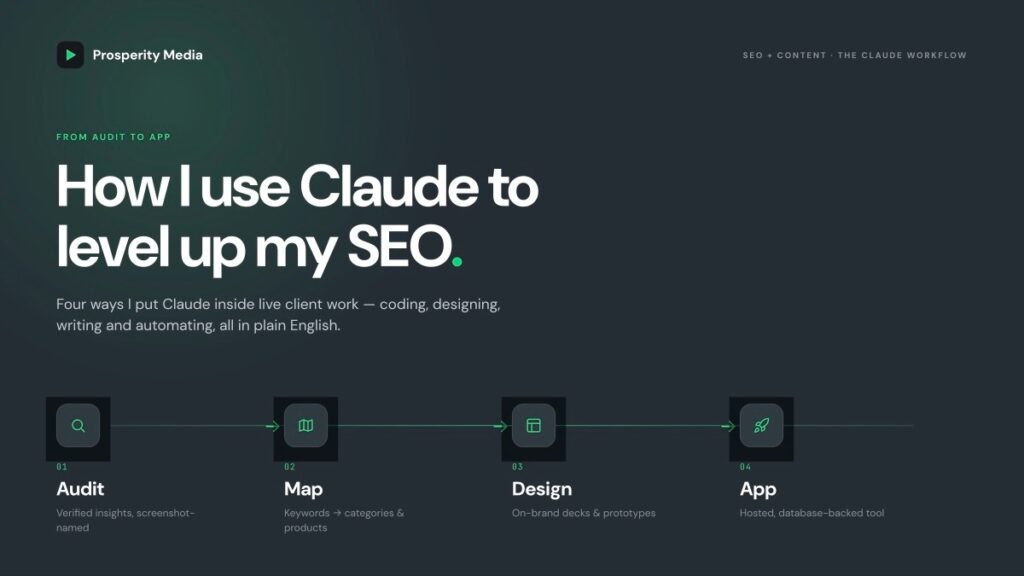
SEO has always been the discipline that borrows. We borrow developer time to ship a fix, designer time to make a deck land, a writer to turn a brief into a page, an analyst to make the numbers mean something. Most of us got passable at all of it, because the alternative was waiting in […]

When you’re trying to create optimised content, large language models like Google AI Mode and ChatGPT can feel like a black box. If content is your bread and butter, you’ll probably struggle to wrap your head around the deepest technical complexities of LLMs. Here’s the good news: You don’t need a computer science degree to […]
Key Takeaways Why Strategy Matters in Digital PR? In the world of digital PR, having a strategy isn’t a ‘nice to have’ – it’s the foundation of success. A strong strategy helps your client stand out against competitors rather than blending into the noise. Without clear direction, digital PR can quickly become a cycle of […]
We just published Prosperity Media’s State of AI Search White Paper and the data should make every brand marketer pay attention. Here are the findings that matter most: The shift is already happening 80% of consumers now rely on AI-generated results for at least 40% of their purchase searches and most of those searches end […]

If you are a marketer working across digital marketing strategy, inbound marketing, or content marketing, chances are you’ve stumbled across the term digital PR. But what does it actually mean, and what makes it different from traditional PR? For people outside of the Digital PR industry, the difference between Traditional and Digital Public Relations can […]
Search engine optimisation (SEO) is one of the most powerful tools in digital marketing, but only when it’s done well. With expert guidance, technical know-how, and custom strategies, a top SEO agency does far more than boost rankings and organic traffic. It can create new markets, stronger ROI, and long-term success in an online landscape […]

Electronic mail, or email (as it is now more commonly known), was invented in 1971 by Ray Tomlinson. Since then, it has slowly replaced snail mail due to its convenience and speed. While instant messaging has expanded quickly, email remains the backbone of professional communication. It is no longer just a means to message friends […]
Our Services
Let’s build something big together.
We’re not here for short-term wins. We’re here to scale what matters — traffic, trust, and growth. Let’s Grow Together
Work with us