Want to increase your sign ups and commissions?


In the hotel business, everyone’s trying to grab the attention of travellers online. To stand out, you need an SEO strategy that shows off what’s special about your hotel.
Our SEO agency understands what it takes to rank in competitive industries. So we’re here to show you what SEO for hotels takes to get your hotel website ranking higher.
Want to increase your sign ups and commissions?
Making your hotel website appear first on Google is what hotel SEO is all about. If you get it right, when people search for a place to stay, your hotel shows up right at the top of organic search. Being at the top means more people click on your site, and that means more bookings.
If your hotel’s website doesn’t show up near the top, people looking for a place to stay might just book with a competitor hotel. This can be a problem as repeat customers are big business in the hotel industry. Once people find something they like they tend to come back again and again.
Figuring out the search terms potential guests use when seeking accommodations online is the goal of your keyword research.
You’ll want your site to be a go-to source for information about hotels and travel. This builds trust with Google, potentially pushing your content up in search results.
Think about what makes your hotel special. Focus on your standout features or services. These will form your pillar pages, attracting visitors and improving your rank for competitive search terms. Use search engine optimisation tools like Ahrefs or Answer the Public to brainstorm article ideas. Make sure you cover everything tied to your hotel’s key services.
For example, if a special feature of your hotel is a “Rooftop Bar,” you can use keyword research tools to create a cluster of related articles:
Once you’ve established this, it’s time to develop hotel SEO content and set up a smart internal linking system.
Best Rooftop Bars in [Location], Signature Cocktails at [Your Hotel Name], Planning the Perfect Evening at a Rooftop Bar.
Correctly linking pages within your hotel website will guide visitors through your site and help them understand what you offer. It also shows search engines how your site is organised, which can boost the visibility of important pages.
Take this page structure as an example:
Homepage > Pillar Page > Articles
Homepage > Luxury Suites > The Ultimate Guide to Luxury Stays
This layout is your base for building a detailed set of topic clusters. Start by writing articles for each pillar page. Your links should follow a framework like this:
Try not to use exact match anchor text every time. For example, if your article focuses on “Luxury Suite Amenities,” mix up the words you use for the anchor text.
Smart internal links spread the strength of your successful pages which can help more of your pages rank well, not just your homepage.
Each article connects back to its pillar page, Each article receives a link from another article in the same cluster, Each pillar page links to the homepage.
Developing a strategy is just the start of hotel SEO. You also need to think about how you implement it. Think about what kind of content you’ll create for your hotel, how often, and where to kick things off.
Your hotel SEO strategy should focus on what will boost your hotel’s visibility the most. Work out which areas are the hardest to rank for but could bring in the most guests. That helps you decide what to tackle first.
Plan your content to showcase your hotel’s unique features. This way, you attract more visitors to your site and get them interested.
Update your blog regularly with travel tips, local attractions and news. This keeps visitors engaged and gives consumers more ways to find you.
When it comes to planning and publishing your content, include the following where necessary:
Remember, strong SEO isn’t only about using relevant keywords. It’s about creating content that’s so good that people want to stay, read, and eventually book their stay at your hotel.
Structured data, Keyword rich headings, Meta description, FAQs.
Making your hotel stand out in local searches is super important. Keep your Google Business Profile updated with the right keywords that match your hotel’s vibe. This helps you perform better on Google Maps and lets guests leave reviews.
The online buzz about your hotel matters a lot. Get your satisfied guests to share their positive experiences. Their reviews can influence future guests and bump up your spot in search results.
For your hotel website’s local SEO, you’ll want to set up pages targeting local searches like “Boutique Hotels in Brisbane.” Do this for every area your hotel targets, but mix up the content to avoid creating duplicate content.
Gaining high-quality backlinks from trusted and niche-relevant sites tells search engines your hotel content is valuable and worth ranking higher.
Here’s how to build those links:
Target a variety of backlinks, especially from travel-related sources, to solidify your website’s credibility. Effective link building not only aids SEO for hotels but can also increase your hotel’s recognition and trustworthiness.
Digital PR, Guest posts, Infographics, Collaborations.
If your hotel website doesn’t have lots of pages, technical SEO might not be as important for you. However, it’s still key to get it right. Check your website annually using tools like Screaming Frog and Google’s Page Insights.
Essentials to work on:
Ensure your website has quick loading times., Make it work great on mobile devices., Use HTTPS for security., Create short, clear, and keyword-rich URLs., Enable search engines to easily crawl your site., Implement structured data to clarify your content., Handle duplicate content with canonical tags or 301’s, Maintain website security., Set up hreflang tags for multiple languages.
Understanding the market is about tuning into the buzz, thinking about what your guests are after, and then making sure your hotel pops up when they start looking. It’s about being in the right place, at the right time, with the right keywords.
Think about what’s trending. Maybe it’s all about having the coolest rooftop bar so then use these trends in your SEO strategy. This means using the right words that potential guests put into Google when they’re dreaming about their next getaway.
Also, keep an eye on your competition. What are they doing that’s making guests flock to them? Use that intel to tweak your own SEO game. Maybe they’re all about luxury spa experiences and your hotel has an awesome spa too. Make sure people searching for a spa getaway find you first.
Travel aggregator websites can pose a problem for hotels in the search engine results pages. They list a bunch of hotels all in one place, making it super easy for travellers to compare prices and options. While this is great for travellers, it’s a bit of a headache for individual hotels trying to get noticed through SEO.
Then there’s the ever-changing world of Google’s algorithms. What works today might not work tomorrow, so you’ve got to keep up and adapt. Monitor Google Analytics and Google Search Console for fluctuations in website traffic. Really it pays to have a team working with you to be able to get the best results.
Matthew Barby
Senior Director of Acquisition at Hubspot

Whenever I have companies ask me if there are any great agencies in Australia, I always point them to Prosperity Media. James and team are always pushing out incredibly impactful work, and their depth of knowledge around SEO and content marketing is up there with the best in the world.
Marcus Lim
Co-Founder & CEO at Oneflare

We have experienced significant uplift and continued growth in organic traffic and have helped us to rank above all our competitors for key search terms.
Hotels
FAQs
SEO is making your website more friendly to search engines which can lead to an increase in organic traffic. In the hotel industry, this means reaching more travellers finding and booking to stay at your hotel.
These are the three main areas of SEO: technical SEO, on-page SEO, and off-page SEO. Each one contributes to making a website more visible and highly ranked by search engines.
To optimise your business for SEO, you’ll need to conduct keyword research, optimise your website’s content and structure and build quality backlinks.



With millions of busy Australians swapping shopping trollies for touchscreens, the battle for product visibility is no longer fought in the supermarket aisle. It’s fought in the search results of supermarket apps and websites. Digital shelf optimisation is the practice of strategically enhancing product listings on shopping platforms, so that when customers scroll through a […]
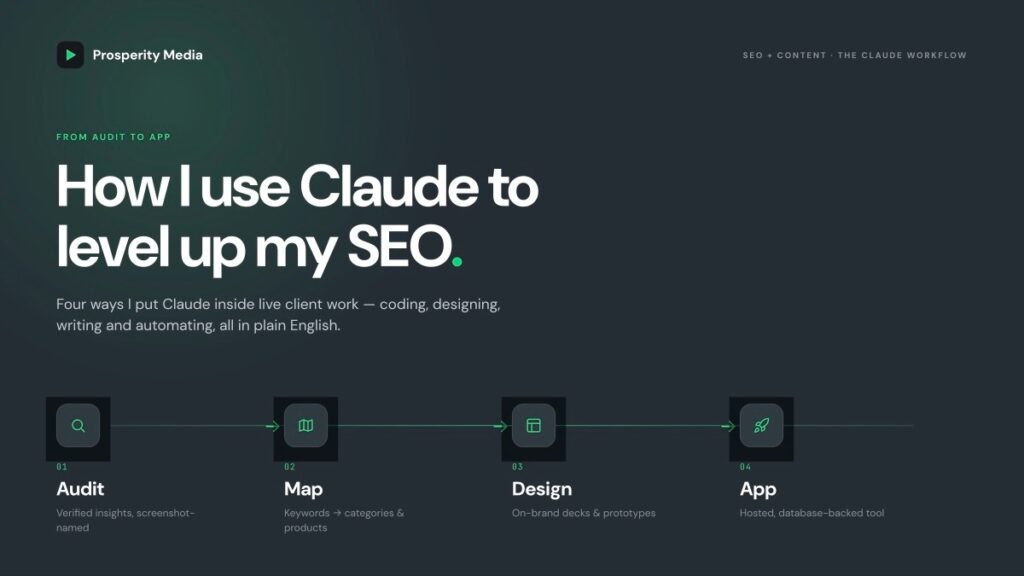
SEO has always been the discipline that borrows. We borrow developer time to ship a fix, designer time to make a deck land, a writer to turn a brief into a page, an analyst to make the numbers mean something. Most of us got passable at all of it, because the alternative was waiting in […]

When you’re trying to create optimised content, large language models like Google AI Mode and ChatGPT can feel like a black box. If content is your bread and butter, you’ll probably struggle to wrap your head around the deepest technical complexities of LLMs. Here’s the good news: You don’t need a computer science degree to […]
Key Takeaways Why Strategy Matters in Digital PR? In the world of digital PR, having a strategy isn’t a ‘nice to have’ – it’s the foundation of success. A strong strategy helps your client stand out against competitors rather than blending into the noise. Without clear direction, digital PR can quickly become a cycle of […]
We just published Prosperity Media’s State of AI Search White Paper and the data should make every brand marketer pay attention. Here are the findings that matter most: The shift is already happening 80% of consumers now rely on AI-generated results for at least 40% of their purchase searches and most of those searches end […]

If you are a marketer working across digital marketing strategy, inbound marketing, or content marketing, chances are you’ve stumbled across the term digital PR. But what does it actually mean, and what makes it different from traditional PR? For people outside of the Digital PR industry, the difference between Traditional and Digital Public Relations can […]
Search engine optimisation (SEO) is one of the most powerful tools in digital marketing, but only when it’s done well. With expert guidance, technical know-how, and custom strategies, a top SEO agency does far more than boost rankings and organic traffic. It can create new markets, stronger ROI, and long-term success in an online landscape […]

Electronic mail, or email (as it is now more commonly known), was invented in 1971 by Ray Tomlinson. Since then, it has slowly replaced snail mail due to its convenience and speed. While instant messaging has expanded quickly, email remains the backbone of professional communication. It is no longer just a means to message friends […]
Our Services
Let’s build something big together.
We’re not here for short-term wins. We’re here to scale what matters — traffic, trust, and growth. Let’s Grow Together
Work with us